Species profile
Idiocnemis nigriventris
Lieftinck, 1937
Taxonomic path
SuborderZygoptera
FamilyPlatycnemididae
GenusIdiocnemis
VUVulnerable
EndemicJayapura
Last updated: 02 July 2026

Diagnosis
Male : Idiocnemis nigriventris is a dark member of the bidentata-group. The male has a yellow labrum with a dark basal mark, light brown anteclypeus, dark brown postclypeus, and a yellow-orange frons. The vertex is black with small brown-grey subtriangular postocellar spots attached to the eye margin. The synthorax has an interrupted antehumeral stripe, divided into an anterior stripe and a posterior elongate spot. The underside of the synthorax is entirely dark brown to black. The abdomen is mostly dark, with pale basal and subdistal markings on the middle segments and purple dorsal markings on segments 8–9. The most important diagnostic character is the male superior anal appendage, where the distal process is reduced to a small tubercle.
Female : The female is similar to the male but generally paler. It can be recognized by the interrupted antehumeral stripe, entirely dark ventral side of the synthorax, and subtriangular postocellar spots attached to the eye margin. The abdominal segments show a sharp border between the pale subdistal markings and the dark distal rings. The cerci are black, which helps separate it from some related species in the bidentata-group.
Morphological Characters
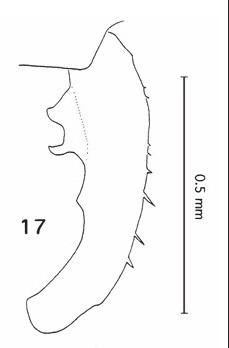
male superior appendage
© Dirk Gassmann (2000)
1 / 1
Locality
Distribution
This species is known from northern Papua, especially the Humboldt Bay area (Jayapura/Hollandia) and its surroundings, in lowland habitats at around 50–100 m a.s.l.
Ecology
Habitat
The exact habitat requirements and ecology of Idiocnemis nigriventris are unknown. However, Kalkman and Orr (2013) report that damselflies in the genus Idiocnemis are 'found at small streams and seepage areas in forest'.
Remarks
Notes
Additional notes will be added in future revisions.
Literature
References
1 references- 1
Gassmann, D. (2000). Revision of the Papuan Idiocnemis bidentata-group (Odonata: Platycnemididae). Zoologische Mededelingen, 74, 18-24, 375–402.