Species profile
Drepanosticta ephippiata
Lieftinck, 1937
Taxonomic path
SuborderZygoptera
FamilyPlatystictidae
GenusDrepanosticta
LCLeast Concern
EndemicNorth and Central Sulawesi
Last updated: 10 July 2026
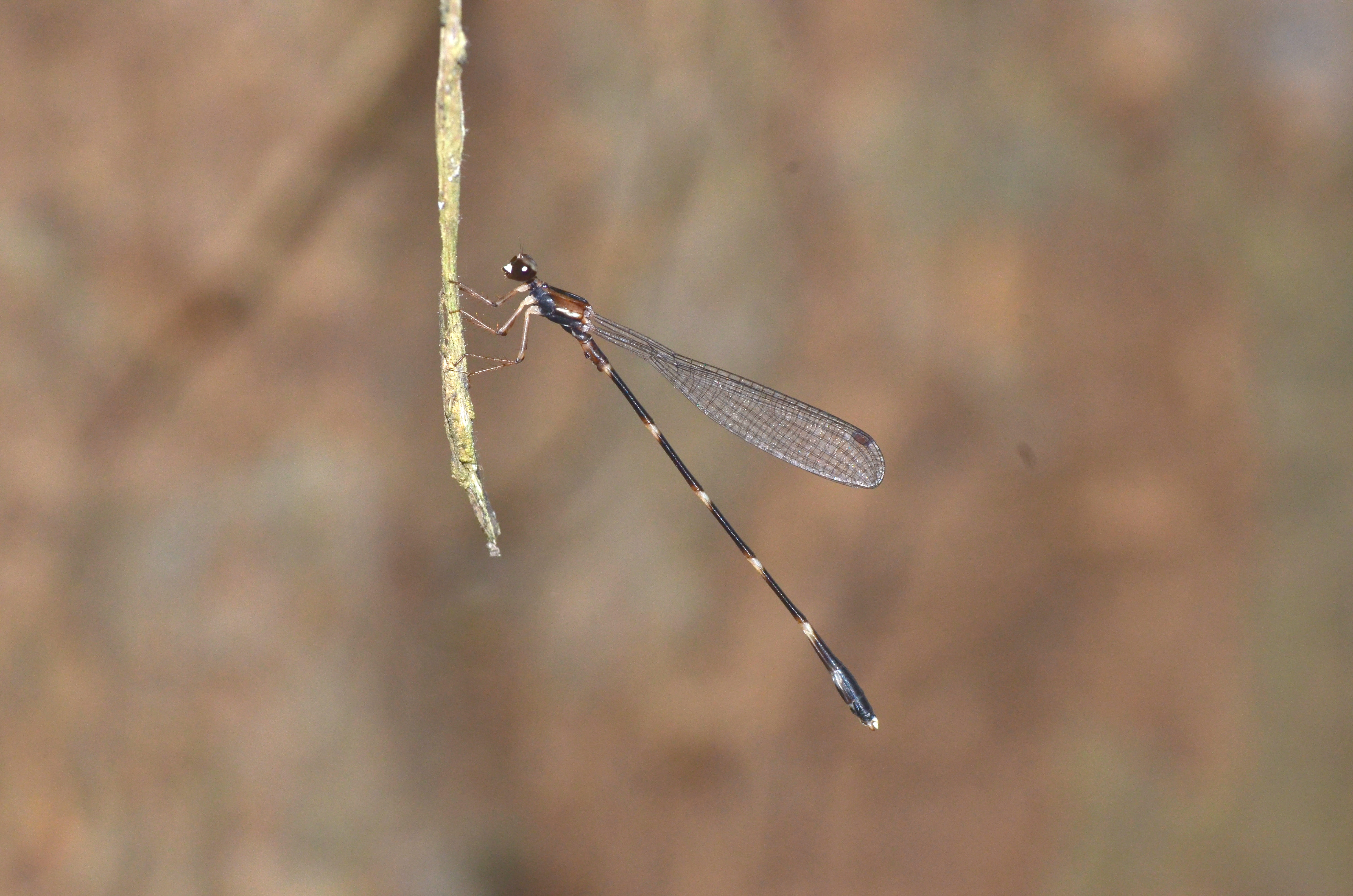
Hanging position
© Raja Rhamdany H
Source: Personal Collection·License: All rights reserved
Diagnosis
Male : A small, brown species distinguished from other Sulawesi Drepanosticta by a pair of slender processes on the posterior margin of the posterior pronotal lobe. The labium is dirty ochreous; the mandibles, labrum, and anteclypeus are bluish white, with the anterior margins of the mandibles and labrum brown to brownish black. The genae are dirty white, while the remaining parts of the head are matt black with a metallic lustre. The transverse occipital carina is distinct, with acute lateral corners.
The prothorax is brown, with the posterior lobe brownish black. Its posterior margin bears a pair of slender processes approximately 1.0–1.5 times as long as the median line of the posterior lobe. They are directed obliquely backwards at about 60°, with the tips directed abaxially. The processes are generally slender and tapering, although the distal portion may be slightly widened or distinctly swollen in some specimens.
The synthorax is dark brown, with a narrow dirty-yellow stripe extending across the mesepimeron and metepisternum from just above the stigma to the posterior margin. The legs are predominantly yellow with darker rings and markings. The wings are hyaline, with brown venation and a brown quadrangular pterostigma.
The abdomen is slender. Segment 1 is brown; segment 2 bears a pair of pale latero-anterior spots; segments 3–6 are brownish black with pale basal rings occupying approximately one-fifth of each segment; segment 7 is dark brown with the basal third paler; and segments 8–10 are brownish black without pale markings. The anal appendages are compact and yellow. The superior appendages are broad basally, taper gradually caudally, and bear a dorsal tooth approximately one-third from the apex. The inferior appendages are very broad basally, with a triangular inner tooth and a posterior concavity; the tips are sharply directed dorso-axially.
Female : Similar to the male, but the posterior margin of the posterior pronotal lobe bears short, triangular, erect projections. Segment 8 has a small pale spot at the latero-anterior corner; segment 9 is brown; segment 10 and the anal appendages are pale. The valves are brown and extend somewhat beyond the anal appendages.
Morphological Characters

1 / 1
Locality
Distribution
Known from northern and central Sulawesi and Peleng Island in the Banggai Archipelago.
Ecology
Habitat
No specific habitat information
Remarks
Notes
Placed alone in the Drepanosticta ephippiata species-group. This group forms part of a broader clade characterized by paired processes on the posterior pronotal lobe, together with the D. lymetta and D. megametta species-groups and an unnamed northern New Guinea group.
D. ephippiata differs from the latter groups in having comparatively slender posterior processes that do not show the strongly broadened or club-shaped form typical of many members of the lymetta and megametta groups. The precise phylogenetic relationships among these groups remain unresolved.
Literature
References
1 references- 1
van Tol, J. (2007). The Odonata of Sulawesi and adjacent islands, part 6. Revision of the genus Drepanosticta Laidlaw (Zygoptera: Platystictidae). Odonatologica, 36(2), 171–189.