Species profile
Nannophyopsis chalcosoma
Lieftinck, 1935
Taxonomic path
SuborderAnisoptera
FamilyLibellulidae
GenusNannophyopsis
VUVulnerable
Last updated: 01 July 2026
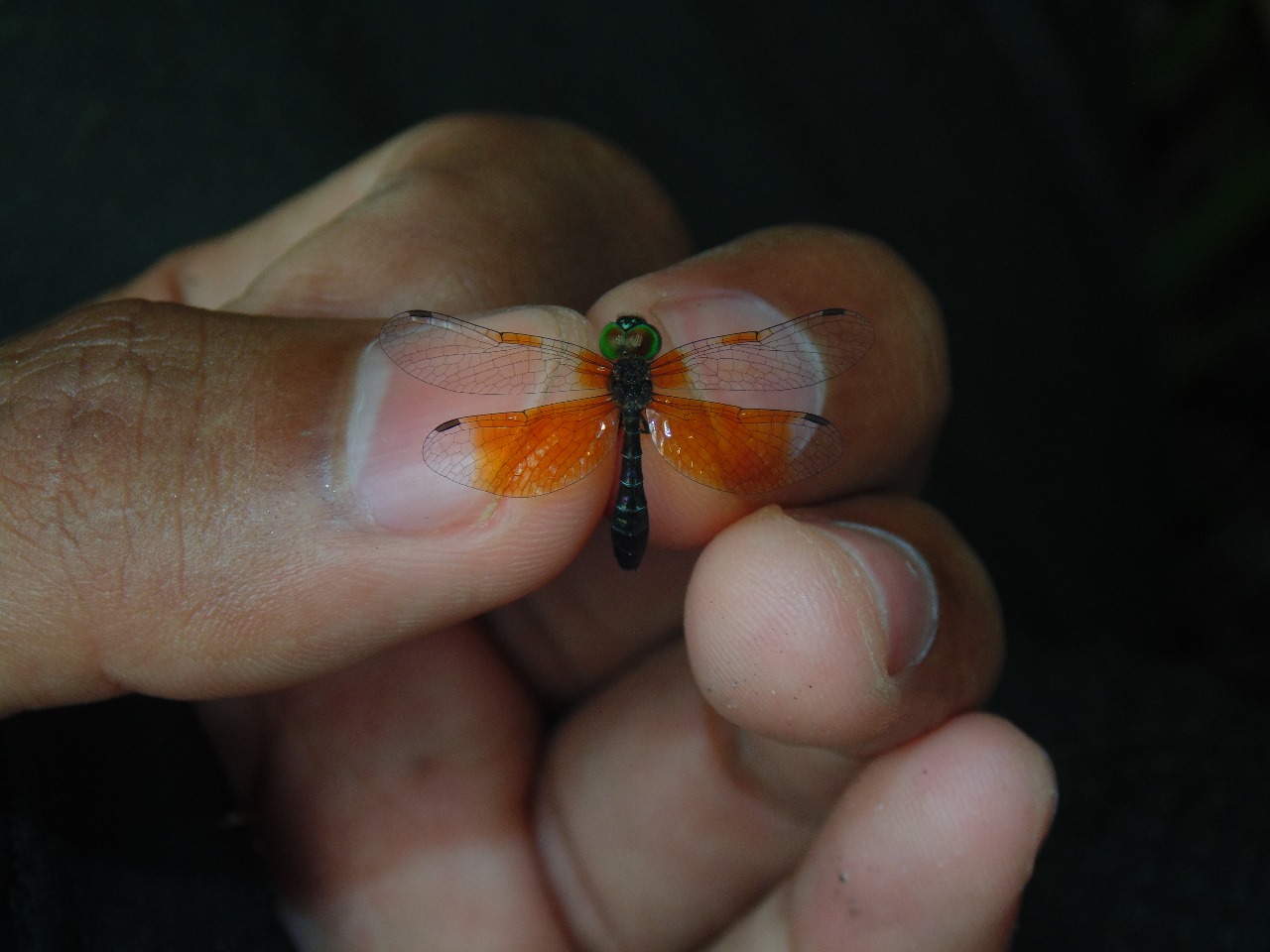
wing detail
© Mirza Irhas
Source: Personal Collection·License: All rights reserved
1 / 3
Diagnosis
A very small libellulid dragonfly characterized by a slender, spindle-shaped abdomen with segments 5–9 progressively widened, producing a weakly clubbed appearance. General coloration glossy black with strong metallic green to bronzy reflections on frons, thorax, and abdomen. Frons metallic green with coppery reflections; eyes chestnut-brown. Thorax short and narrow, predominantly black with metallic green sheen dorsally and slight coppery reflections laterally. Wings hyaline; basal area of hind wing suffused with golden-yellow coloration. Pterostigma elongate, narrow, greyish-brown.
Male distinguished by comparatively large and projecting secondary genitalia; superior appendages slender, nearly straight in dorsal view, slightly incurved apically; inferior appendages broad basally, tapering distally and slightly upturned apically. Female generally similar to male but larger and more robust, with broader wings and more extensive golden-yellow basal wing coloration.
Nannophyopsis chalcosoma differs from related small Libellulidae by the combination of minute body size, metallic black coloration, narrow thorax, distinctly spindle-shaped abdomen, elongate pterostigma, and reduced anal field of the hind wing.
Morphological Characters

1 / 1
Locality
Distribution
Kalimantan and Sumatra (Belitung island)
Ecology
Habitat
In Borneo this species appears to be restricted to low pH waters but this is not the case in Belitung. It has been found in a variety of habitats (including man-made ones): ponds, pond-like and slow flowing sections of streams and swamp forest including peat swamp forest. It appears to require forest but at some locations the forest is degraded. It is apparently absent at most locations meeting the above description, so we probably do not fully understand its habitat requirements, but it does appear to be very sensitive to changes. Source = The International Union for Conservation of Nature (IUCN)
Remarks
Notes
Additional notes will be added in future revisions.
Literature
References
3 references- 1
Lieftinck, M . A. (1935): A Synopsis of the Odonata (Dragonflies) of Sumatra. Miscellanea Zoologica Sumatrana 1: 1-23
- 2
Lieftinck, M. A. (1935 b) New and little known Odonata of the Oriental and Australian Regions. Treubia, 15 (2), 175-207.
- 3
Dow, R. A., Choong, C. Y., Grinang, J., Lupiyaningdyah, P., Ngiam, R. W. J. & Kalkman, V. J. (2024) Checklist of the Odonata (Insecta) of Sundaland and Wallacea (Malaysia, Singapore, Brunei, Indonesia and Timor Leste). Zootaxa, 5460 (1), 1-122.